


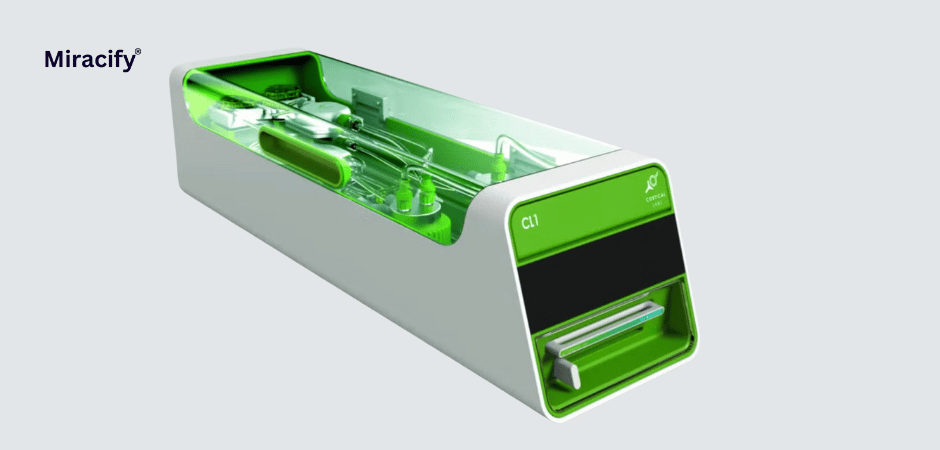
In the evolving world of computing, where artificial intelligence, quantum devices and neuromorphic chips dominate the headlines, an entirely new paradigm has quietly emerged: biological computing. At the forefront of this shift is the CL1, developed by Cortical Labs (Australia) in collaboration with other entities, which blends living human neurons with silicon hardware to form what the company calls a “code‐deployable biological computer”.
In this blog post, we will explore the CL1 in depth: its origins, how it works, its technical architecture, potential applications, ethical and practical considerations, as well as what it might mean for the future of computing and research.
The Origins & Context
A Move Beyond Silicon
Conventional computing and AI have made tremendous strides in recent decades—all driven by silicon‐based hardware, transistor scaling, specialized chips and vast data centres. But even as this continues, certain limitations have become increasingly visible: high energy consumption, diminishing returns from Moore’s Law, and the large amounts of data required to train models.
Biological systems—specifically neurons in the human brain—offer a radically different template. They are highly efficient in energy use, flexible in learning from sparse data, and self‐organising. The idea: instead of simulating brain‐like networks on silicon, why not harness actual neural tissue? The CL1 is precisely that leap.
The Company and the Launch
Cortical Labs describes itself as pursuing “synthetic biological intelligence (SBI)” and offers the CL1 device and a cloud platform (the “Cortical Cloud”) to enable deploying code directly to cultured neurons.
The CL1 was publicly announced in early 2025, with the company launching it as the “world’s first commercially available biological computer” of its kind.
What is the CL1?
Core Concept
At its core, the CL1 is a hybrid device. Human (or human‐derived) neurons are grown in vitro, placed on or integrated with a silicon chip, and interfaced bi‐directionally: the chip sends electrical impulses to the neurons, the neurons respond, and those responses then feed back into an external system.
Device Architecture & Specifications
- The neuron population may contain around 800,000 human-derived neurons.
- A built-in life-support bioreactor maintains nutrients, waste management, gas exchange and temperature.
- The silicon component includes a high-density electrode array and a “Biological Intelligence Operating System (biOS)”.
- Power consumption is extremely low (around ~20W in some cases).
- Neuron cultures live for up to six months under stable conditions.
- Retail pricing starts around $35,000 per device.
Learning & Operation
CL1 extends the foundational ideas of the earlier “DishBrain” system, where neurons learned to play Pong. In the CL1, neurons can be stimulated, trained, and monitored through a closed-loop system. Users can deploy code directly to the neurons, interact with external devices, and treat the neuron layer as a programmable biological substrate.
Potential Applications
1. Disease Modelling & Neuroscience Research
The CL1 provides a highly controlled environment of human‐derived neural tissue. Researchers can use it to study neurodegenerative diseases, test drugs, explore neural plasticity and model disease-specific cell behaviours. Its human-centric nature can reduce reliance on animal models.
2. Low-Power Intelligent Computing
Biological neurons learn with massive energy efficiency compared to silicon-based AI. This could pave the way toward low-energy adaptive computing systems that learn dynamically and require far less data.
3. Robotics, Sensors & Actuators
One of CL1’s most exciting aspects is real-time integration with external devices. Cameras, actuators, robotic sensors and digital interfaces can be connected to the neuron network, enabling experiments where biological neurons directly control physical machines.
4. Fundamental Computing Research
The CL1 opens the door to exploring computing foundations using biological substrates—offering insights into learning, intelligence, network formation and biological-electronic interactions.
Advantages & Unique Features
- Adaptive biological learning with extremely low energy use.
- Human-specific neurological behaviour, valuable for research.
- Closed-loop real-time interfacing with digital and physical systems.
- Commercially available, unlike most biological computing systems.
- Energy efficient compared to large-scale AI systems.
Limitations, Challenges & Ethical Considerations
Technical Limitations
- Neuron count is far smaller than an actual brain.
- Neuron cultures have a limited lifespan of around six months.
- Learning behaviour is not deterministic.
- Integration with existing computing ecosystems remains challenging.
- Benchmarking biological systems is still a new science.
Ethical & Philosophical Questions
- Could a sufficiently large neural network develop subjective experience?
- How should donor consent be handled for neural tissue?
- What oversight is required as biological computing scales?
- How should society respond to machines containing living human cells?
How CL1 Compares to Other Computing Paradigms
- Digital computing: Deterministic and scalable, but energy heavy.
- Neuromorphic computing: Mimics the brain but remains silicon-based.
- Quantum computing: Solves specialised problems but doesn’t learn.
- Biological computing (CL1): Uses living neurons for real biological intelligence.
Practical Considerations for Institutions & Researchers
- Requires biological lab capabilities and sterile handling.
- Cross-disciplinary expertise (software + neuroscience) is needed.
- Cost and ongoing consumables must be budgeted.
- Experiments must be designed to leverage biological learning.
- Ethics and biosafety approvals are essential.
- Neuron culture lifespan affects long-term projects.
Looking Ahead: What the Future Might Hold
- Greater neuron scale and complexity in future devices.
- Improved software, interfacing tools and electrode arrays.
- Growth of “Wetware-as-a-Service” platforms.
- Deep integration with robotics and adaptive control systems.
- New frameworks for ethics, biosafety and neural-computing oversight.
- Hybrid systems combining biological, quantum and digital computing.
Why the CL1 Matters
- It fundamentally redefines what computing can be.
- It introduces the world to hybrid silicon–neuron machines.
- It opens new pathways for neuroscience, drug testing and AI research.
- It challenges society to rethink intelligence, computation and consciousness.
- It is the first step toward a new era of biological computing.
The CL1 from Cortical Labs represents a bold and provocative step into the next frontier of computing: not just more silicon, faster processors or deeper neural network layers, but living neurons grown and interfaced on chips to perform meaningful work.
While the technology is young and many questions remain technical, ethical and regulatory the fact that such a device is commercially available marks a turning point. The CL1 is not simply a machine; it is a prototype of a new class of intelligent bio-electronic systems.
The future of CL1 and biological computing will depend on researchers, ethicists, engineers and society working together to use this technology ethically and effectively. It is an exciting moment in the history of computation, where the boundary between biology and technology grows thinner than ever.
Miracify Strengthens Businesses in Their Innovation Journey
Digital innovation is no longer a luxury it is a necessity for growth in today’s competitive business landscape. Miracify empowers companies to build powerful digital products, adopt modern technologies, and create long-lasting value for their customers.
Through strategy, design, engineering and continuous improvement, Miracify acts as a true technology partner in innovation.